
Housewrap has been the default weather-resistive barrier on production homes for decades, and mechanically fastened sheet wrap is a known quantity: familiar to crews, inexpensive per roll, and fast to install on a simple, flat wall. A liquid-applied barrier does the same core job, keeping bulk water out and controlling air leakage, but it does it as a continuous coating instead of a stapled sheet. The two approaches solve the same problem in fundamentally different ways, and the difference shows up exactly where walls actually fail: at seams, at fasteners, and at corners.
This is a direct comparison, not a case against housewrap in every situation. Housewrap works when it is detailed correctly and every lap, seam, and penetration is taped and shingled the way the manufacturer specifies. The question this post answers is what happens when that perfect execution is not guaranteed, which is the real condition on most jobsites and especially on production schedules where the same detail repeats across many homes and many crews.
We use Tower Laboratorio AU-1 as the liquid-applied reference point throughout, since it is designed to serve as both the flashing at openings and the full weather-resistive barrier across the wall field in one product.
Respuesta rápida
Housewrap is a mechanically fastened sheet product that relies on correctly taped seams, shingled laps, and separate flashing at openings to work. A liquid-applied barrier like Tower AU-1 LAB cures into one continuous membrane with no seams, self-seals around fasteners, and flows into corners and penetrations without cutting or folding. Housewrap can perform as well as a liquid barrier when every detail is executed correctly, but its performance depends heavily on installer consistency. A liquid-applied barrier removes most of that variability because the result is the same continuous film regardless of who applied it, which matters most on production schedules where the same detail repeats across many homes.
How Each System Actually Works
Housewrap
Housewrap is a synthetic sheet material, typically spun or woven polyolefin, mechanically fastened to the sheathing with staples or cap nails. It is installed in horizontal courses working up the wall, with each course overlapping the one below it, and vertical seams taped or lapped at the studs. Rough openings are detailed separately with flashing tape, and every penetration through the wrap needs its own flashing or sealant detail. The wrap itself does not seal around the fasteners that hold it on.
Liquid-Applied Barrier
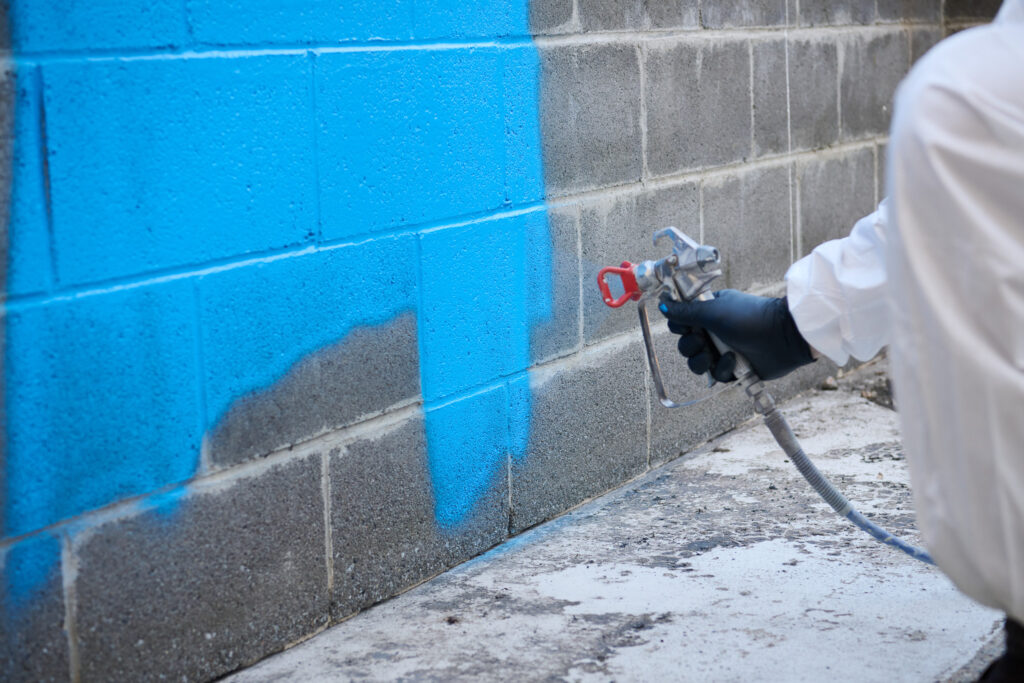
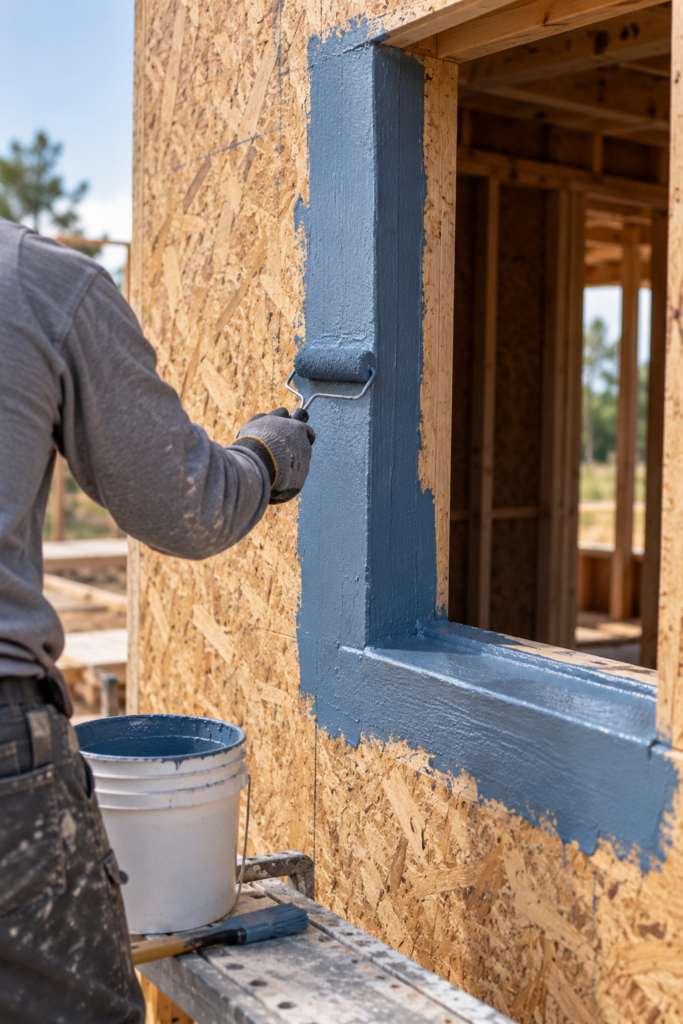
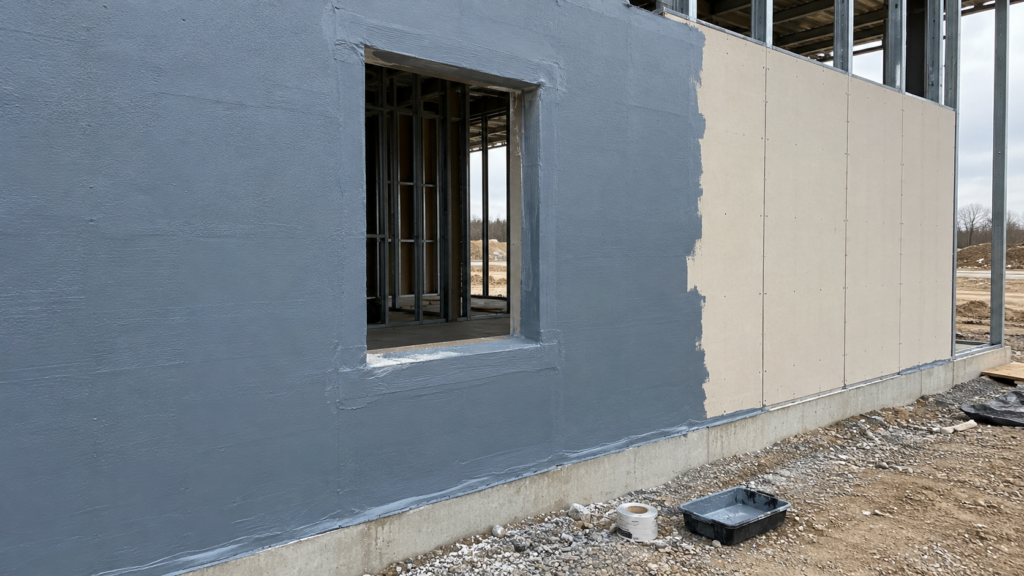
A liquid-applied barrier like AU-1 LAB is a coating rolled, brushed, or sprayed directly onto the sheathing. It cures in place into a single continuous membrane with no fasteners, no laps, and no separate seams to detail. The same material used across the field can also be worked into rough openings and around penetrations, so the flashing and the field barrier are one continuous application rather than two separate systems joined together.
Head-to-Head Comparison
The table below compares the two systems across the factors that determine whether a wall actually stays dry.
| Factor | Liquid-Applied Barrier (AU-1 LAB) | Housewrap |
|---|---|---|
| Seams and laps | None; single continuous membrane | Every horizontal and vertical overlap is a potential leak point |
| Fastener sealing | Self-seals around properly driven fasteners | Staples and cap nails are not individually sealed |
| Rough openings and penetrations | Same material flows into corners and around penetrations | Requires separate tape, cuts, and folds at every opening |
| Air barrier continuity | Continuous by nature of the application | Continuity depends on every seam and fastener being properly detailed |
| Installer dependency | Low; consistent result at correct thickness regardless of crew | High; performance depends on correct shingling, taping, and fastening |
| Wind and weather resistance during install | Not affected by wind once applied | Can be difficult to fasten and tape correctly in high wind |
| Substrate compatibility | No primer needed on most substrates; compatible with green concrete | Designed primarily for sheathing, not masonry or concrete |
| Full WRB plus flashing in one product | Yes, one product for both | No; requires a separate flashing product at every opening |
| Application method | Brush, roller, or airless sprayer | Mechanically fastened by hand, course by course |
| Field performance record | Newer to widespread production use; performs best when applied to spec thickness | Long field history; performs well when every detail is executed correctly |
Where Housewrap Genuinely Holds Its Own
Housewrap is not an inferior product; it is a product whose performance is more sensitive to execution. On a simple, flat wall with square openings and an experienced crew that tapes and shingles correctly every time, housewrap performs well and has decades of field history behind it. It is inexpensive per roll, familiar to nearly every framing crew in the country, and fast to hang on straightforward wall sections.
The tradeoff is that its performance is not built into the material the way it is with a liquid-applied system. It is built into the installation. A roll of housewrap installed poorly performs worse than a liquid barrier applied competently, and a roll of housewrap installed to spec, on a simple wall, by a careful crew, performs close to what a liquid-applied barrier delivers automatically. The real question for a builder is not which material is better in a lab test. It is which system holds up when installation conditions are not ideal, which on a real jobsite is most of the time.
Where the Gap Widens: Complexity and Scale
The comparison changes as the wall gets more complex or the home count gets larger.
- Complex openings. Recessed windows, non-standard window sizes, and walls with multiple penetrations are where housewrap’s tape-and-fold approach struggles most. Every corner is a cut, a fold, or an overlap, and each one is a place the tape can be applied wrong. A liquid barrier flows into these shapes without any of that detailing.
- Crew turnover and multiple crews. Production builders do not use the same three framers on every home. Different crews, different days, different weather conditions all introduce variability into how well housewrap is taped and fastened. A liquid-applied barrier removes most of that variability because the result depends on application thickness, not on how carefully someone folded a corner.
- Repetition across many homes. A single housewrap detailing mistake on a custom home is one problem. The same mistake repeated by the same crew across every home in a phase of a community is a pattern, and it usually is not caught until a callback surfaces on one of the homes and prompts a look at the rest.
What AU-1 LAB Specifically Brings to This Comparison
Not every liquid-applied product closes the full gap with housewrap. Some liquid flashing products are detail-only, meant for openings and penetrations, and still require a separate mechanically fastened WRB across the field, which reintroduces the seam and fastener issues this comparison is about. AU-1 LAB is built to cover both roles.
It meets the performance requirements of AAMA 714-22 and has been tested in accordance with ABAA weather-resistive barrier requirements. It requires no primer on most common substrates, including concrete, masonry, OSB, plywood, and exterior gypsum, which extends its usefulness beyond wood-framed sheathing to masonry and precast conditions that housewrap was never designed for. It is compatible with green concrete, and it can be exposed to weather and UV for up to nine months before cladding is required, which fits the phased schedules that production builders actually run.
The comparison is not liquid versus housewrap in the abstract. It is whether the barrier system’s performance depends on the material itself or on the execution of every seam, fastener, and corner across every home in a community. AU-1 LAB is built around removing that dependency.
FAQ: Liquid-Applied Barrier vs Housewrap
Is a liquid-applied barrier better than housewrap?
It depends on execution. A liquid-applied barrier removes most of the installer dependency that housewrap relies on, since it cures into one continuous membrane regardless of who applies it. Housewrap can perform just as well when every seam, lap, and fastener is detailed correctly, but that consistency is harder to guarantee across many homes and crews.
Does housewrap seal around fasteners?
No. The staples and cap nails that hold housewrap to the sheathing are not individually sealed by the wrap itself. A liquid-applied barrier like AU-1 LAB self-seals around properly driven fasteners as it cures.
Can AU-1 LAB replace housewrap entirely?
Yes. AU-1 LAB is designed to serve as the full weather-resistive barrier across the wall field, not just as detail flashing at openings, so it can replace housewrap rather than supplementing it.
Is liquid-applied barrier more expensive than housewrap?
Material cost per square foot and labor time vary by project and application method, so a direct cost comparison should be confirmed for your specific program. The relevant comparison for a production builder is total cost, including callback and warranty exposure, not material cost alone.
Does a liquid-applied barrier work on masonry or concrete, not just wood sheathing?
Yes. AU-1 LAB requires no primer on most common substrates including concrete, masonry, OSB, and plywood, and it is compatible with green concrete. Housewrap is designed primarily for wood-framed sheathing.
Why does installer consistency matter more for housewrap than for a liquid-applied barrier?
Housewrap’s performance is built into the installation: correct shingling, taping, and fastening. A liquid-applied barrier’s performance is built into the material and the application thickness. Applied correctly, it produces the same continuous result regardless of which crew applied it or which day it was applied.
Conclusion: The System That Depends Least on Perfect Execution
Housewrap and liquid-applied barriers are both capable of protecting a wall assembly. The difference is where that performance comes from. Housewrap’s performance lives in the installation, in every correctly shingled course, every properly taped seam, and every carefully detailed corner. A liquid-applied barrier’s performance lives in the material itself, cured into one continuous membrane that does not depend on any of those individual steps going right.
For a single, simple, well-supervised project, that difference may not matter much. For a production builder repeating the same wall detail across many homes and many crews, it is the difference between an envelope that performs consistently and one that performs only as well as its most rushed installation. Tower AU-1 LAB delivers the seamless, self-sealing, one-product approach, meeting AAMA 714-22 and ABAA-tested performance requirements while covering both the flashing and the full field barrier in a single application.
To evaluate AU-1 LAB against your current housewrap system for a specific project or production program, Contáctese con el equipo de Tower Sealants. Visita towersealants.com o llame 866-897-7568.