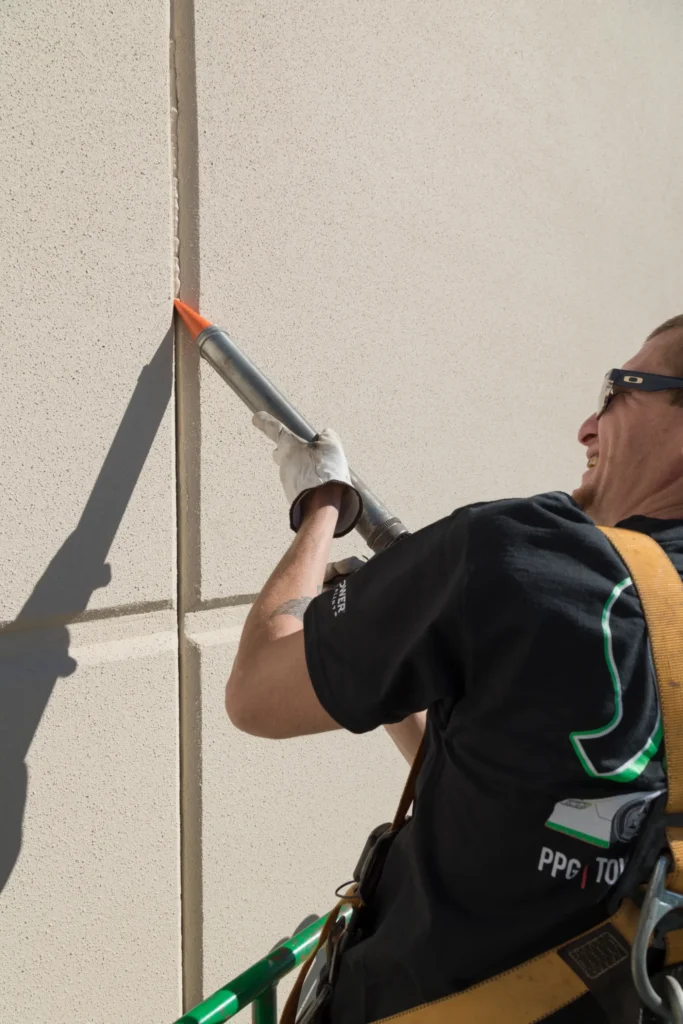

Vacuum-fill technology is a manufacturing process that uses negative pressure to eliminate trapped air during sealant cartridge filling. Vacuum-filling prevents air-pops, the sputtering that creates a mess, waste and cleanup from a failed bead. The process removes air pockets between the plunger and the sealant mass before the cartridge is sealed, which prevents premature curing, extends shelf life, and eliminates the air bubbles and application inconsistencies that cause callbacks on commercial projects. For professional contractors working with specification-grade products, vacuum-fill technology is the difference between a cartridge that performs reliably from first squeeze to last and a cartridge that delivers inconsistent beads and wasted material.
Most commercial contractors have experienced the frustration of starting a job with a fresh cartridge that sputters, spits air, or delivers an uneven bead on the first few triggers. The trapped air bubbles are compressed when you gun product out, then when you release the pressure, the bubble expands, and that’s what causes “run out” or “drool”. This creates a mess whenever you set a caulk tube down that has air pockets in it. Standard filling methods push sealant into the cartridge from the nozzle end and then insert the plunger from the back, which traps a pocket of air between the two. Vacuum-fill technology solves that problem by evacuating the air before the plunger seals the cartridge.
This post explains how vacuum-fill technology works, why it matters for sealant performance and shelf life, and what it means for contractors who depend on consistent material flow on job sites where downtime costs money. If you are specifying or purchasing professional-grade construction sealants and want to understand what separates a premium product from a commodity tube, vacuum-fill technology is part of that conversation.
| Quick AnswerVacuum-fill technology evacuates trapped air from sealant cartridges during manufacturing using negative pressure applied at the plunger end while the cartridge fills. This eliminates air pockets that cause sputtering, premature curing, and shelf-life degradation. Professional-grade sealants manufactured with vacuum-fill technology deliver consistent beads from first use, last longer in storage, and eliminate the air-related application problems that waste time and material on commercial job sites. |
Why Trapped Air Matters: The Problems Vacuum-Fill Technology Solves
Trapped air inside a sealant cartridge creates a host of problems that affect performance on commercial projects: application inconsistency, premature curing, and shelf-life degradation. Each one costs time, wastes material, or shortens the usable life of the product. Additionally, the vacuum sealing used by Tower Sealants prevents run-out, or drooling because of the air bubble expanding in the cartridge. Tiny air pockets can be hidden inside of caulk beads, this creates a bead that will lose its seal very easily, or it can prevent adequate adhesion to both sides of the substrates.
Application Inconsistency and Sputtering
When a caulk gun plunger pushes against the cartridge plunger, it compresses any trapped air before it starts moving the sealant. That compressed air eventually releases through the nozzle as a burst that disrupts the bead. The first few triggers on a cartridge with trapped air deliver inconsistent flow, air pockets, and uneven material distribution. On a window perimeter or an expansion joint, that inconsistency shows up as voids, thin spots, and gaps that require rework.
Vacuum-fill technology eliminates that problem by removing the air before the cartridge leaves the factory. The first squeeze delivers sealant with no compression lag, no air bursts, and no flow interruption. On a commercial project where a crew is running linear feet of sealant per day, consistent flow from cartridge start to cartridge finish keeps the work moving without stops for purging air or restarting beads.
Premature Curing and Shelf-Life Degradation
Most elastomeric sealants cure through reaction with moisture in the air. A cartridge with trapped air behind the plunger exposes the back end of the sealant mass to oxygen and humidity. Over time, that exposure causes the sealant to cure from the inside out. The first symptom is a skin forming on the sealant surface inside the cartridge. The final result is a partially cured mass that does not flow properly and cannot be applied. Tower Sealants’ water-based products cure is ambient, meaning the air will cure the product by drying it out.
This is why cartridges stored for extended periods sometimes start strong and then become stiff or unworkable halfway through. The air trapped at the back of the cartridge initiated a slow cure process that degraded the material over months in storage. Vacuum-fill technology extends shelf life by eliminating that air exposure. The sealant stays sealed from moisture and oxygen until the cartridge is punctured and loaded into a caulk gun.
For contractors stocking sealant for future projects or distributors warehousing inventory, shelf life matters. A cartridge that fails in storage before it reaches a job site is wasted product and wasted cost. Vacuum-fill manufacturing protects that investment by keeping the sealant stable and workable through its rated shelf life.
Air Bubbles During Application
Air trapped within the sealant mass shows up as bubbles that pop out during application. A bead with air voids is not a weathertight seal. The voids create pathways for water and air infiltration, and they compromise the integrity of the joint. On structural glazing or curtainwall weatherseals, air voids are a specification failure that requires removal and replacement.
Vacuum-fill technology prevents air from being incorporated into the sealant during filling. The negative pressure pulls air out as the material flows into the cartridge, which eliminates the bubbles before they become trapped in the cured bead. The result is a dense, void-free sealant that cures to full strength and maintains adhesion across the entire bond line.
Vacuum-Fill Technology vs. Standard Filling: The Quality Difference
Standard cartridge filling is a pressure-driven process. Sealant is pumped into the cartridge through the nozzle end, and a plunger is inserted to seal the back. The process is fast and works well for low-viscosity materials that flow easily and release air naturally. For high-viscosity elastomeric sealants, standard filling traps air because the material is too thick to allow the air to escape during the fill cycle.
Vacuum-fill technology adds a secondary air-removal step that standard filling skips. The vacuum phase pulls trapped air out after the cartridge is filled but before the plunger seals completely. That extra step increases manufacturing time and requires specialized equipment, which is why vacuum-fill technology is rare. Tower Sealants uses a proprietary vacuum-fill technology at every step in the manufacturing process, and are the only ones in the industry using this process.
The quality difference shows up in four measurable ways. First, vacuum-filled cartridges deliver consistent bead volume from first trigger to last with no air compression lag. Second, they maintain shelf stability longer because there is no air exposure at the back of the cartridge. Third, they produce void-free beads with better adhesion and weatherproofing performance because the cured sealant is denser and more uniform. Fourth, it prevents “run-out” or “drool”, which creates a mess and waste as the pressure continues to release caulk even after the gun has been set down.
For a contractor running sealant on a commercial building envelope, those differences translate to fewer callbacks, less rework, and more linear feet of completed joint per cartridge. The upfront cost difference between a vacuum-filled professional product and a standard-filled commodity tube is offset by the labor savings and performance reliability on the job site.
What Vacuum-Fill Technology Means for Commercial Contractors
For contractors purchasing sealant for commercial projects, vacuum-fill technology is a quality indicator that separates professional-grade products from lower-tier options. It signals that the manufacturer invested in process control and quality assurance at the production level, which correlates with better performance at the application level.
When you are specifying sealant for a project with performance requirements, inspection schedules, and warranty obligations, product consistency matters. A cartridge that sputters air on the first squeeze or develops shelf-life problems before the job starts creates delays and rework that eat into your margin. Vacuum-fill technology eliminates those variables by ensuring that every cartridge in the box performs the same way.
Tower Sealants manufactures AU-1 Commercial Construction Sealant and other professional-grade products using vacuum-fill technology. The process is part of the quality control system that delivers consistent performance across every cartridge in every case. For contractors who depend on reliable material flow and long-term joint performance, that consistency is what justifies the investment in a specification-grade product.
Common Questions About Vacuum-Fill Technology in Sealant Manufacturing
Does vacuum-fill technology affect sealant chemistry or curing?
No. Vacuum-fill technology is a mechanical process that removes air during cartridge filling. It does not change the sealant formulation, cure mechanism, or performance characteristics. The sealant that comes out of a vacuum-filled cartridge is chemically identical to the same product filled using standard methods. The difference is in the absence of trapped air, not in the material itself.
Can I tell if a cartridge was vacuum-filled by looking at it?
Not from the outside. Vacuum-filled cartridges look identical to standard-filled cartridges. The difference is internal and becomes apparent during use. A vacuum-filled cartridge delivers consistent material flow from the first trigger with no air sputtering or compression lag. A standard-filled cartridge may sputter or pop air on the first few squeezes as trapped air compresses and releases. However, sometimes you can see the difference by shining a flashlight at the bottom of the tube, revealing the air pockets inside.
Does vacuum-fill technology increase the cost of sealant?
Yes, slightly. Vacuum-fill manufacturing requires additional equipment, longer cycle times, and more process control than standard filling. That cost shows up in the wholesale price of the product. For professional contractors, the cost difference is offset by reduced material waste, fewer callbacks, and better shelf-life performance. The upfront price premium is small compared to the cost of rework or failed joints on a commercial project.
Is vacuum-fill technology used for all types of sealant?
No. Vacuum-fill technology is most common in professional-grade elastomeric sealants like acrylic urethane and high-performance silicone where material consistency and shelf life are critical. Low-viscosity caulks and general-purpose residential products are typically filled using standard methods because those materials release air naturally during filling and the performance requirements are less demanding.
How long does a vacuum-filled cartridge last in storage?
Shelf life depends on the sealant formulation, not the filling method. Vacuum-fill technology extends shelf life by eliminating trapped air that causes premature curing, but it does not change the rated shelf life on the product data sheet. Most professional-grade elastomeric sealants have a shelf life of 12 to 18 months when stored in a cool, dry location. All of the Tower Sealants water-based products have a shelf life of 24 months.. Vacuum-fill manufacturing ensures the product stays workable through that entire period without degradation from internal air exposure.
Does vacuum-fill technology eliminate all air bubbles in the sealant?
It eliminates trapped air between the plunger and the sealant mass, which is the primary source of air-related application problems. Vacuum-fill technology also reduces air incorporation during the filling process by maintaining negative pressure as the material flows into the cartridge. The result is a denser, more uniform sealant with minimal voids. Perfect air elimination requires proper application technique as well, including correct backer rod installation and proper tooling to avoid entraining air during bead placement.
Is vacuum-fill technology the same as vacuum degassing?
No. Vacuum degassing is a separate process that removes dissolved air from the bulk sealant before it is pumped into cartridges. Degassing happens in the mixing tanks at the production facility. Vacuum-fill technology happens during cartridge filling and removes trapped air from the cartridge cavity after the sealant is inside. Some manufacturers use both processes. Degassing removes air from the material. Vacuum-fill removes air from the cartridge.
Conclusion: Why Vacuum-Fill Technology Matters for Professional Sealant Performance
Vacuum-fill technology is not a marketing feature. It is a manufacturing process that solves real problems contractors face on job sites: inconsistent material flow, premature curing, and air-related application defects. For professional crews working under performance specs and inspection schedules, those problems cost time and create callbacks. Vacuum-fill manufacturing eliminates them at the source by removing trapped air before the cartridge is sealed.
Tower Sealants uses vacuum-fill technology in AU-1 Commercial Construction Sealant and other professional-grade products as part of a quality control system designed for commercial and industrial applications. The process ensures that every cartridge delivers consistent performance from first squeeze to last, maintains shelf stability through rated storage periods, and produces void-free beads that meet weatherproofing and adhesion requirements.
If you are specifying sealant for a commercial project or stocking inventory for future work, vacuum-fill technology is one indicator of product quality and process control. It signals that the manufacturer invested in the equipment and procedures necessary to deliver professional-grade consistency. For more information on Tower Sealants products and manufacturing standards, visit towersealants.com or call 866-897-7568.